
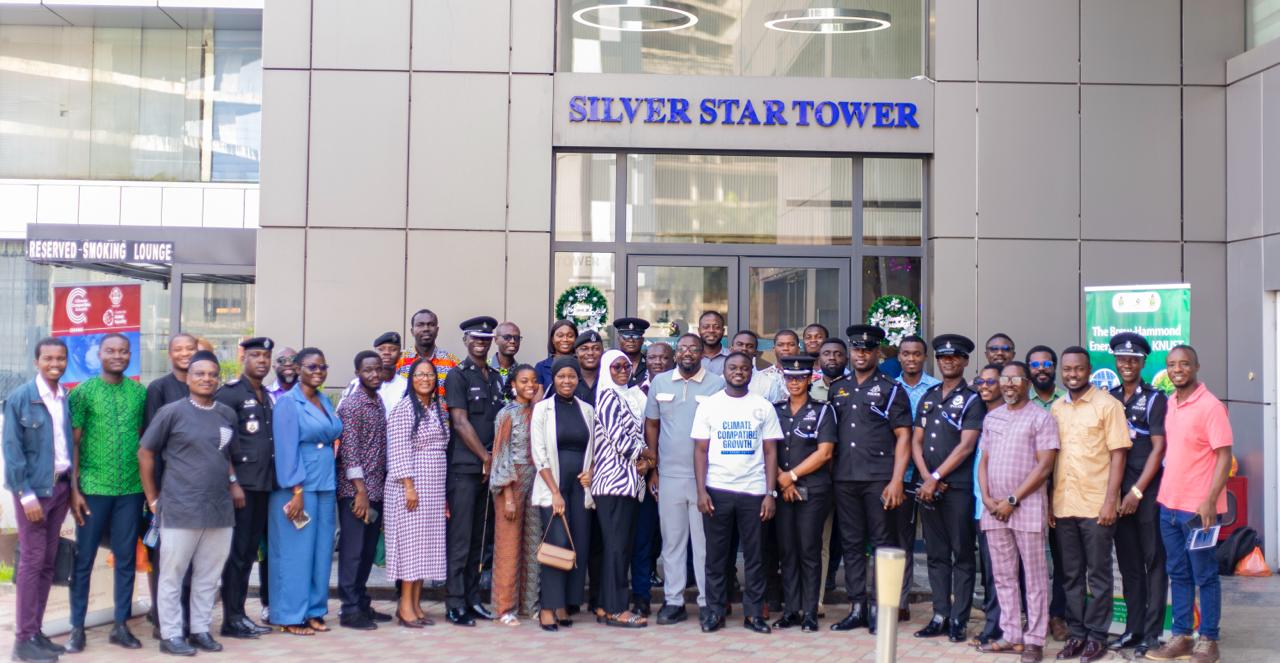
As debates over electric vehicle safety and adoption continue in Ghana, the Brew-Hammond Energy Centre and the Climate Compatible Growth Programme held a two-day stakeholder primer aimed at informing policy discussions and correcting misconceptions on EVs.
The workshop underscored the need for regulators, manufacturers and transport stakeholders to align innovation with safety, infrastructure readiness and consumer awareness as Ghana positions itself within the global shift towards electric vehicles.
Dr. Godwin Ayetor, Group Chair and Special Interest Group (SIG) lead for the Electric Vehicles and Sustainability Group at the Centre, tackled widespread safety concerns that continue to influence public opinion and regulatory debates on EV adoption.
Drawing on international accident and insurance data, Dr. Ayetor dispelled the notion that electric vehicles are inherently unsafe. He explained that while EVs and Plug-in Hybrid Electric Vehicles (PHEVs) record slightly higher crash involvement than internal combustion engine vehicles, the difference is marginal and largely influenced by factors such as driving behaviour and vehicle design.
According to the data presented, EVs show about a four per cent increase in crashes, while PHEVs record a six per cent increase. EVs were also found to be 6.7 per cent more expensive to repair, mainly due to battery systems and specialised components. Dr. Ayetor stressed that such evidence “should be considered explicitly by regulators, manufacturers and insurance providers” as Ghana develops policies for electric mobility.
Addressing concerns about fire risks, he noted that although EV fires often attract heightened public attention, they are not more common than fires involving conventional vehicles. He explained that battery fires behave differently and require specialised response measures, but do not necessarily pose a higher overall risk.
Dr. Ayetor also dismissed claims that EV batteries expire quickly, explaining that battery degradation is gradual and can be managed through proper charging practices. He highlighted that factors such as speed, temperature, traffic conditions and air-conditioning usage significantly affect performance, noting that air-conditioning alone can reduce driving range by up to 31 per cent.
He warned that misinformation remains a major barrier to EV adoption in Ghana, calling for sustained public education, improved standards and data-driven policymaking to support a safe transition to electric mobility.
Joyce Caitlyn Ocansey, Project Coordinator for the Drive Electric Initiative at the Energy Commission, revealed the extensive studies undertaken by the commission on e-mobility to guide regulation. She noted that the Energy Commission, together with the Ghana Standards Authority, has developed standards for electric vehicles, batteries and charging equipment, adding that “there are standards, but we need to move to enforcement.”
She noted that a 2021 baseline study on public perception showed that many Ghanaians were willing to invest in electric vehicles.
“As regulators, once people are using and charging these vehicles, we must regulate it,” she said, explaining that the findings were meant to inform policy.
According to her, regulation is necessary to ensure safety and oversight in the manufacturing, importation, sale and supply of electric vehicles as the sector expands.
The Director of Education, Research and Training at the Police Motor Traffic and Transport Department (MTTD), Chief Superintendent Alexander Kwaku Obeng, described the workshop as an eye-opener, noting that the transition from internal combustion engine vehicles to EVs presents new responsibilities for safety and property protection.
“We have a revolution in our hands in our lifetime where internal combustion engine vehicles are giving way to electric vehicles. This is why we are here ... we have a responsibility to protect the lives and property of Ghanaians,” he said.


